
How to Repair Heat Damaged Hair

There’s a moment most people with heat damaged hair can pinpoint exactly. Not when the damage happened, but when they finally noticed it. You’re running your fingers through your hair and something feels wrong. The ends are rough. The hair that used to feel silky after a blowout now feels like straw within hours. You stretch a strand between your fingers and instead of bouncing back, it just breaks. And suddenly you’re doing the math on how many times a week you’ve been using a flat iron at the highest setting for the past two years.
Heat damage is frustrating precisely because it’s so quiet in the way it builds. It doesn’t announce itself. It accumulates, slowly and invisibly, until the day it becomes impossible to ignore. The good news is that with the right approach and a realistic mindset, most people can bring their hair back to a genuinely healthy place. The key word there is realistic. Understanding what recovery actually looks like, and what it doesn’t look like, is the first and most important step.
What Heat Damage Actually Does to Your Hair
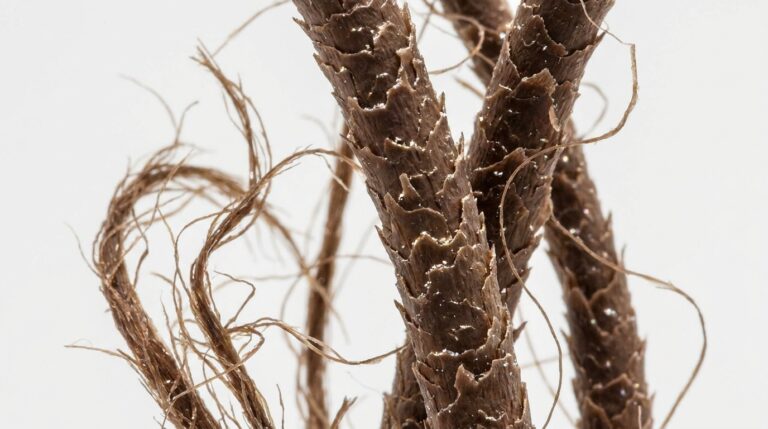
Hair is protected by a cuticle layer made up of overlapping microscopic scales. When those scales lie flat, your hair looks shiny, feels smooth, and holds onto moisture effectively. When you apply high heat repeatedly, those scales lift, crack, and eventually break down. The inner structure of the hair strand, which contains the proteins and moisture responsible for strength and elasticity, becomes exposed and vulnerable. This is why heat damaged hair feels rough to the touch and refuses to hold moisture no matter how much conditioner you use. Nothing is sealing it in properly because the cuticle that’s supposed to do that job has been compromised. It also explains why heat damaged hair tends to look dull and flat rather than shiny, since shine comes from light reflecting off a smooth, flat cuticle surface, and a lifted, uneven cuticle scatters that light instead.
The deeper the damage, the more the internal protein structure is affected. Heat at extreme temperatures breaks down the disulfide bonds within the hair strand itself. These are the bonds that give hair its natural curl pattern and overall texture. This is why people with naturally curly or wavy hair sometimes notice certain sections going almost completely straight after prolonged heat use. The bonds that create the curl have been altered, and rebuilding them requires specific treatments rather than standard conditioning alone.
The ends of your hair are always the most vulnerable. They’re the oldest part of each strand, the furthest from the scalp’s natural oils, and the part that takes the brunt of heat tool contact most often. If your ends look frayed, feel like a completely different texture from the rest of your length, or seem to break off every time you try to style them, heat damage is almost certainly the cause regardless of how the rest of your hair looks.
The Signs to Look For
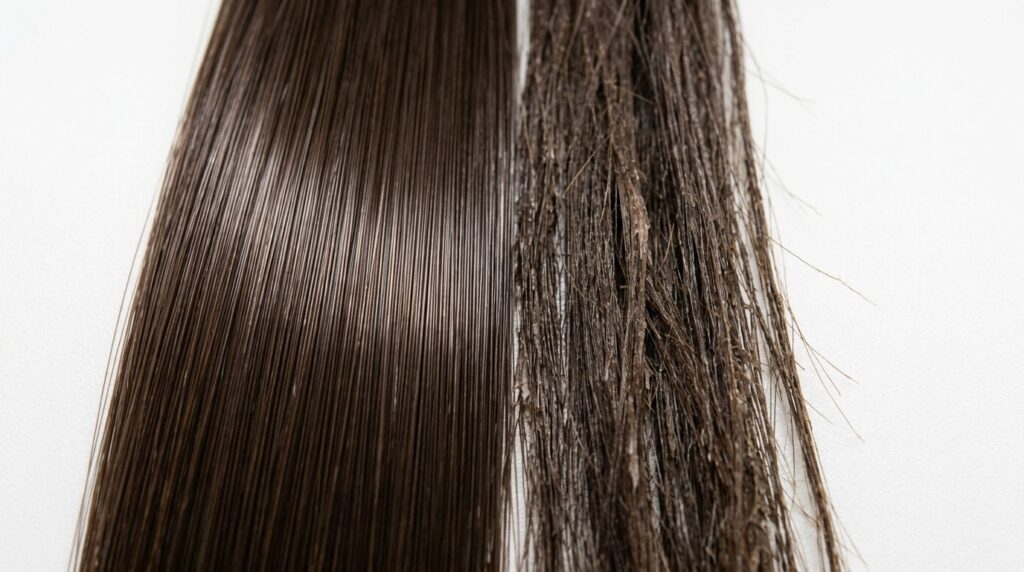
The elasticity test is the most reliable way to check. Take a single strand of hair, hold it between two fingers, and gently stretch it. Healthy hair stretches before it breaks and then springs back close to its original length. Heat damaged hair snaps quickly with almost no stretch at all, because the internal protein structure has been weakened to the point where it can no longer handle tension properly.
Persistent dryness that won’t respond to conditioning is another major signal. If you deep condition your hair and it still feels dry within a day or two, that’s your cuticle failing to seal moisture in rather than a product problem. You can pour every hydrating ingredient on the market onto your hair and it won’t make a lasting difference if the cuticle layer isn’t intact enough to lock it in.
Frizz, breakage, and a change in your natural texture are the three signs that tend to show up together in heat damaged hair. If you’ve noticed all three at once, especially if they developed gradually over months rather than appearing suddenly, that pattern is a strong indicator that cumulative heat damage is the culprit.
Step One: Stop the Cycle
The single most important thing you can do is put the heat tools down. This is the step people resist most, and also the one that makes everything else more effective. Continuing to apply high heat to already compromised hair while simultaneously trying to treat it is like trying to fill a bucket with a hole in it. You can add as much moisture and protein as you like, but if the damage is ongoing, you’ll never actually get ahead of it. Every heat styling session on already-fragile hair sets the recovery back, even when you’re being careful about it.
Most hair professionals recommend a minimum of four to eight weeks completely heat free when dealing with significant damage, and longer if the damage is severe. The adjustment period is real, especially if your daily routine has revolved around a flat iron for years. This is a good time to explore heatless styling methods like braiding damp hair overnight for waves, using flexi-rods or perm rods for curls, or simply learning what your natural texture actually does when it’s left to its own devices. Products like curl creams, mousses, and leave-in conditioners can help you get comfortable with your natural texture while it recovers. Many people are surprised to discover their natural hair is actually quite beautiful once it has had time to rest and rehydrate properly.
One thing people often discover during a heat break is that their hair looks and feels noticeably better within just a few weeks, not because the damage has reversed, but because the daily stress of heat on already-fragile hair has stopped. The improvement can feel almost immediate, which is a good reminder of how much ongoing heat use was contributing to the problem.
Step Two: Trim What Can’t Be Saved
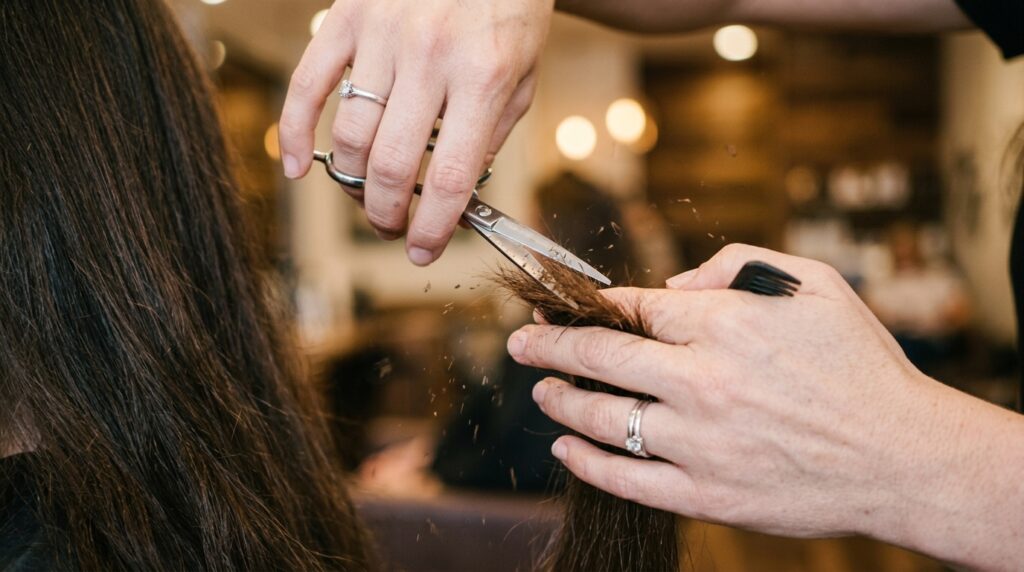
Split ends and severely damaged ends do not get better with treatment. This is one of the most commonly misunderstood facts in haircare. A split end is a physical break in the hair fiber, and no conditioner or mask can fuse it back together. The only thing that happens if you leave split ends alone is that the split travels further up the hair shaft over time, causing more breakage and undermining the health of hair that would otherwise be fine. Trimming removes the problem instead of letting it spread.
You don’t have to lose dramatic amounts of length to see a real difference. Even half an inch to an inch off the most damaged ends can transform how your hair feels overall. If the thought of losing length makes you hesitant, consider this: hair that gets regular small trims to remove damage consistently grows out looking and feeling healthier than hair that’s left untouched but continuously breaking at the ends. The person who trims usually ends up with more usable length over time, not less.
If the damage runs several inches up the hair shaft, a more significant cut may genuinely be the fastest route back to healthy hair. It’s worth asking your stylist to show you where the damage ends and the healthier hair begins. Sometimes seeing that boundary clearly makes the decision much easier.
Step Three: Rebuild From the Inside Out
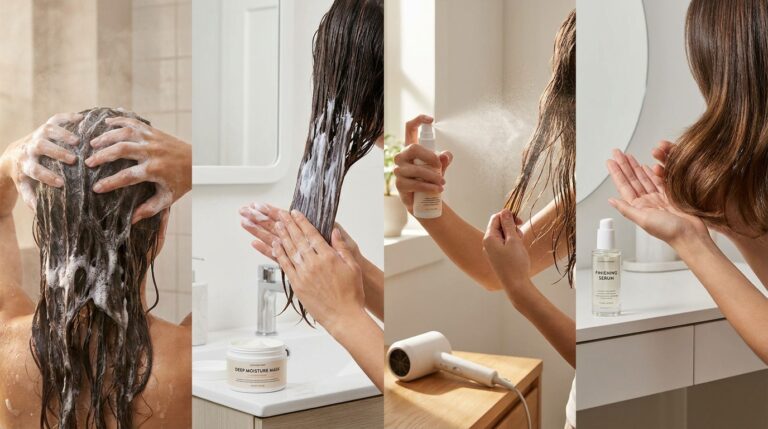
Deep conditioning is the foundation of any heat damage recovery routine. Once a week at minimum, using a rich, penetrating deep conditioner that contains ingredients like shea butter, aloe vera, glycerin, or hyaluronic acid. Apply it to clean, damp hair, cover with a shower cap or a warm towel, and leave it on for at least 20 to 30 minutes. The warmth helps the product penetrate the hair shaft rather than just sitting on the surface. The difference between a rinse-out conditioner left on for two minutes and a proper deep conditioning treatment left on for half an hour is significant, and it’s a difference most people can feel immediately after rinsing. If you can only add one thing to your routine during the recovery phase, make it this.
Protein treatments are the other essential piece of the puzzle. Heat damage breaks down the keratin protein that gives hair its strength and structure. Protein treatments, containing ingredients like keratin, hydrolyzed wheat protein, or rice protein, temporarily fill in the gaps in the damaged cuticle and reinforce the hair fiber from the outside. They make hair feel noticeably stronger and less prone to breakage, even before any new growth comes in. The effect isn’t permanent since these treatments are filling in damage rather than reversing it, but used consistently they make a genuine and visible difference in how the hair behaves day to day.
The balance between moisture and protein is something people often get wrong. Too much protein without enough moisture makes hair feel stiff, brittle, and prone to snapping. Too much moisture without protein leaves hair feeling soft but weak and limp. The most effective approach is usually alternating between the two, a protein treatment one week and a deep moisture treatment the next, and paying attention to how your hair responds. If it feels stiff and snaps easily, add more moisture. If it feels mushy and limp, bring in more protein. Your hair will tell you what it needs if you pay attention to the signals it’s giving you.
Step Four: Rethink Your Daily Routine
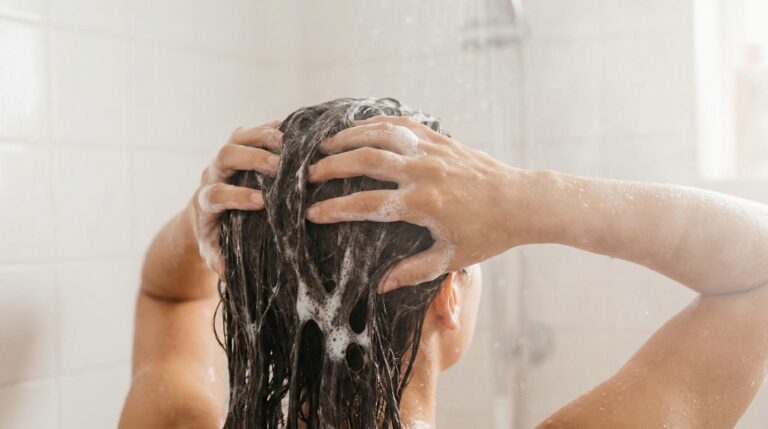
Switching to a sulfate-free shampoo is a small change that makes a real difference. Sulfates are the cleansing agents in many conventional shampoos that create that heavy lather, and they’re effective at cleaning, but they’re also quite stripping. For heat damaged hair that’s already struggling to hold moisture, losing even more to a harsh shampoo twice a week is counterproductive. A gentler sulfate-free formula cleans without stripping, and you’ll likely notice your hair feeling softer and less squeaky-dry after washing almost immediately. Washing less frequently during the recovery phase also helps, since every wash is an opportunity for moisture loss, and allowing your scalp’s natural oils a little more time to work their way down the hair shaft between washes actually supports the recovery process.
A leave-in conditioner should become a non-negotiable step on every wash day. Where your rinse-out conditioner adds moisture during the shower, a leave-in seals it in afterward and provides a light protective layer over the hair shaft throughout the day. It also makes detangling significantly easier, which matters a great deal when your hair is fragile. Think of it as the final step that locks in all the work your deep conditioner and rinse-out conditioner just did.
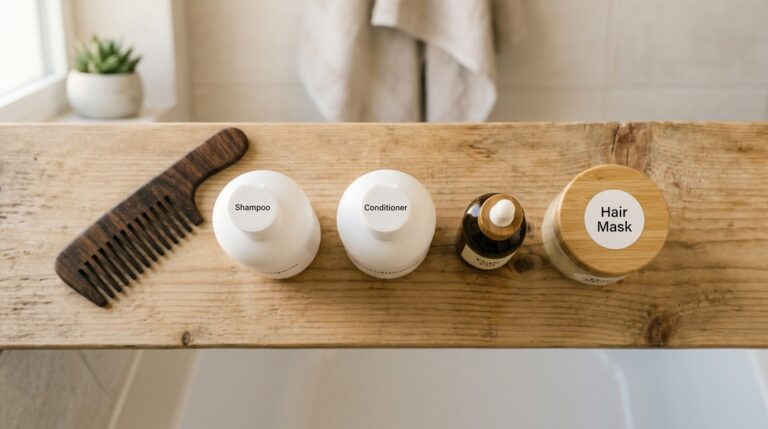
Be genuinely gentle when detangling. Heat damaged hair breaks more easily than healthy hair under tension. Using a wide-tooth comb or your fingers, starting from the ends and working your way up gradually rather than dragging a brush from root to tip, prevents a surprising amount of breakage. A lot of the breakage people attribute to their damaged hair is actually coming from rough detangling habits, and fixing that alone can produce a noticeable reduction in shedding and snapping within a few weeks.
Protect your hair while you sleep. Cotton pillowcases create friction against the hair overnight, lifting the cuticle repeatedly across several hours. For hair whose cuticle is already compromised, this friction adds up meaningfully. Switching to a satin or silk pillowcase, or sleeping with your hair loosely wrapped or braided, reduces overnight friction and helps your hair retain moisture through the night. It’s the kind of change that feels minor but compounds significantly over weeks and months of consistent use.
Step Five: Return to Heat Thoughtfully
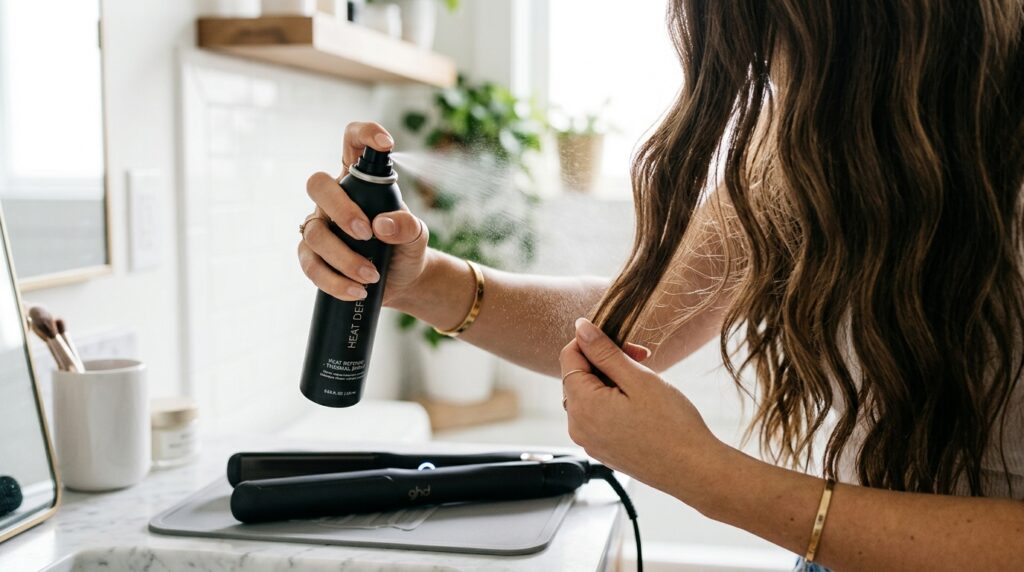
Heat protectant is not optional anymore. If it was something you used occasionally before, it needs to become a fixed step every single time you pick up a heat tool going forward. A good heat protectant creates a barrier between the tool and the hair fiber that distributes heat more evenly and reduces direct damage to the cuticle. Apply it evenly, work it through with your fingers, and give it a moment to dry slightly before styling.
Lower your temperature settings than you think you need. Most hair types genuinely do not require the maximum heat setting to style effectively. Fine or previously damaged hair should stay under 300 degrees Fahrenheit. Medium texture hair can handle up to around 350 degrees. Very thick, coarse hair is the only type that realistically needs higher than that, and even then, the lowest effective temperature is always the better choice for long-term health.
Work in smaller sections and make fewer passes. Every time you run a flat iron or wand over the same section of hair repeatedly, the cumulative heat exposure compounds. Smaller sections styled in a single clean pass are both more effective and significantly less damaging than large sections gone over three or four times trying to get every piece to cooperate.
What to Realistically Expect
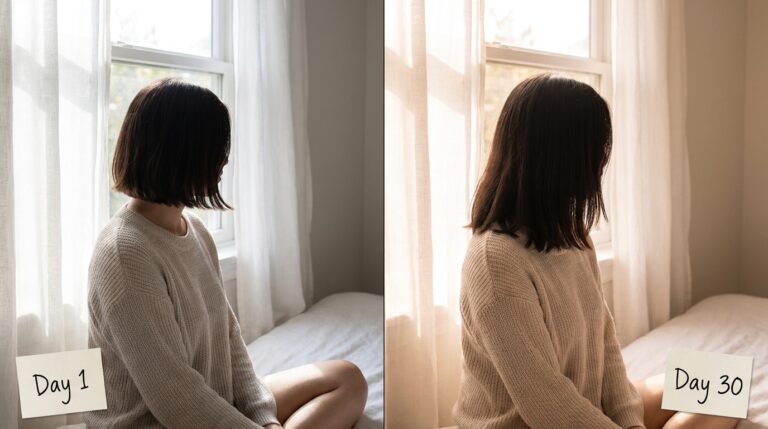
Recovery from heat damage is a long game, and being honest about that upfront makes the process a lot less discouraging. The first signs of improvement, softer texture, less breakage, more manageable frizz, typically show up within four to six weeks of consistent treatment and a heat break. These improvements are real and worth celebrating, but they reflect the surface-level repair from conditioning and protein work rather than full structural recovery.
The real, lasting transformation comes as new healthy growth replaces the damaged lengths over time. Hair grows roughly half an inch per month on average, which means working through several inches of damaged hair takes months regardless of what you put on it. For most people dealing with significant heat damage, a realistic full recovery timeline is somewhere between six months and a year, sometimes longer.
The people who come out the other side with genuinely healthy hair are almost always the ones who committed to the process consistently rather than doing intensive treatments for two weeks and then reverting to old habits. Deep conditioning every week, gentle handling every day, and patience with the timeline are the actual ingredients. There’s no shortcut that replaces them.
Frequently Asked Questions
Can heat damaged hair fully recover without cutting it?
Technically the damaged hair itself cannot be fully repaired, only managed. But with consistent moisture and protein treatments, you can significantly improve how it looks and feels while the damaged sections grow out. Cutting accelerates the visible recovery because you’re removing the compromised hair rather than waiting for it to grow past the ends naturally. Most professionals recommend both treating and trimming rather than choosing one over the other.
How long does it take to see results from deep conditioning?
Most people notice their hair feeling softer and more manageable within two to four weeks of consistent weekly deep conditioning. The improvements become more significant over time as treatments build on each other rather than delivering a single dramatic result.
Is it possible to over-condition heat damaged hair? Yes, particularly with moisture-heavy treatments used too frequently without balancing protein. Over-moisturized hair can feel overly soft, limp, and actually more prone to breakage because it lacks structural support. Alternating between moisture and protein treatments prevents this.
What ingredients should I look for in products for heat damaged hair?
For moisture: shea butter, aloe vera, glycerin, hyaluronic acid, and coconut oil. For protein: keratin, hydrolyzed wheat protein, rice protein, and silk amino acids. A good recovery routine uses both categories rather than focusing exclusively on one.
Can I use heat at all while my hair is recovering?
It’s best to avoid it entirely for the first four to eight weeks if the damage is significant. After that, occasional, low-temperature heat use with proper heat protectant is generally fine, as long as it doesn’t become a daily habit again.